
Customs warehouse: types, security and liability
Key Takeaways
- A customs warehouse is an approved storage location where non-Union goods can be stored without import duties or import VAT becoming due immediately.
- There is no statutory maximum storage period: goods may remain until placed under another procedure, destroyed, or exported again.
- The Netherlands recognises two practical forms: public customs warehouse type II for multiple users, and private customs warehouse for the licence holder alone.
- Under a private warehouse the licence holder carries full liability; under a public type II warehouse the licence holder and the user are separate.
- If goods are resold to a customer outside the EU, import duties and import VAT on that portion are never paid at all.
A customs warehouse is a storage location approved by customs where you can store non-Union goods without paying import duties and import VAT. Those charges are suspended until the moment you actually release the goods for free circulation.
If you resell the goods to a customer outside the EU, you never pay them at all. That makes the customs warehouse not only a liquidity instrument but a genuine saving for anyone using Europe as a distribution hub.
The question that goes with it is rarely answered: do you apply for a licence yourself, or do you place your goods in someone else’s warehouse? That difference determines who is liable when something goes wrong, and it is a bigger decision than most importers think.
In this article we explain which types of customs warehouse exist in the Netherlands, how liability is divided, what security you must provide, what you may do with the goods during storage, and how to apply for a licence.
What is a customs warehouse and what does it deliver?
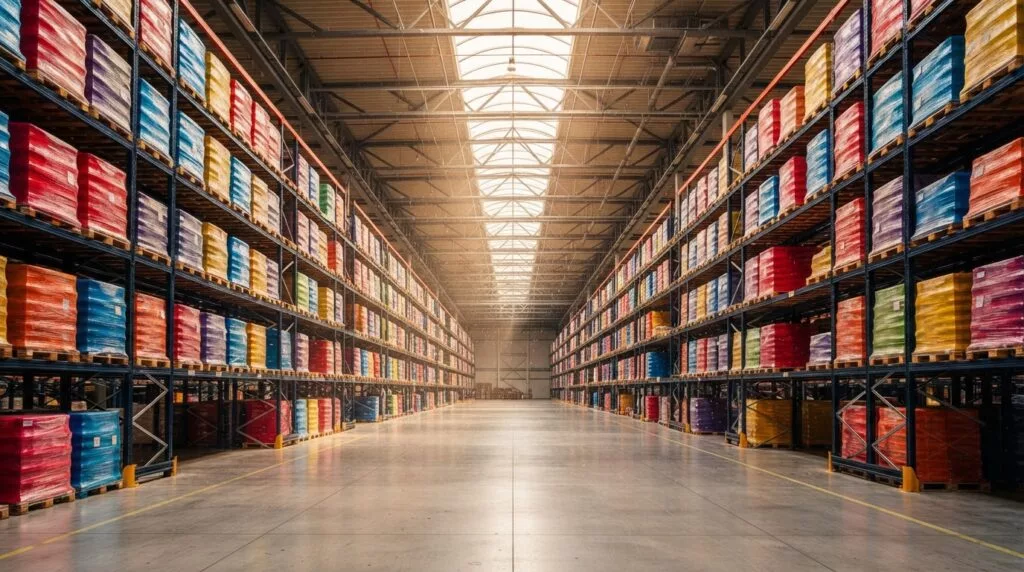
A customs warehouse is a special procedure under the Union Customs Code. Goods stored there are physically in the EU but have not been imported in customs terms. There is therefore no free circulation, and no import duties or import VAT are due.
There is no statutory maximum storage period. Goods may remain in the warehouse until you place them under another customs procedure, destroy them, or they leave the customs territory of the Union.
The three situations where this genuinely produces money:
- You hold European stock but do not yet know when you will sell, and do not want to finance the import duties months in advance
- Part of your stock will eventually go to customers outside the EU, and you never want to pay import duties on that
- You are waiting for a licence, a certificate or an inspection and want the goods close to the market in the meantime
What it is not: a way of getting around the rules. The goods are under customs supervision the whole time, the record keeping is strict, and customs can look back years during an audit.
Which types of customs warehouse exist in the Netherlands?
The Union Customs Code distinguishes two main forms, and that distinction is about who may store the goods.
A public customs warehouse may be used for the storage of goods by anyone. A private customs warehouse may be used for the storage of goods by the holder of the licence.
Of the public variants the code recognises type I, type II and type III. In the Netherlands, type I and type III do not occur in practice. What you encounter here is therefore almost always one of these two:
- Public customs warehouse type II, abbreviated CW2, where several parties can store goods
- Private customs warehouse, abbreviated CWP, where only the licence holder stores their own goods
If you still come across the designations type A to E, you are reading outdated information. That classification comes from the old Community Customs Code and lapsed with the introduction of the Union Customs Code.
Who is liable when something goes wrong?
This is the point where the choice between the two forms actually matters, and it is explained on virtually no service provider’s page.
In a private warehouse, two roles coincide. The licence holder is also the holder of the procedure, and therefore carries full responsibility for the goods, the records and the suspended charges.
In a public type II warehouse those roles are separate. The licence holder manages the location and the records, but the holder of the procedure, meaning whoever places the goods there, remains responsible for the customs debt on their own goods.
In practice that means the following. If you store with a logistics provider holding a CW2 licence, you outsource the management but not your liability. If stock goes missing or the records do not add up, you are the one who becomes liable for the import duties and VAT.
That is not a reason not to do it. It is a reason to know what your contract with the warehouse keeper says about stock discrepancies, stocktaking and reconciliation of the records.
What security must you provide?
For a customs warehouse you must provide security. That security covers the import duties and taxes that would be due if the goods were removed from customs supervision.
The amount depends on the nature and the value of the goods you hold in storage on average. For a warehouse with highly taxed goods or excise goods, the security is therefore considerably higher than for low-taxed bulk goods.
If you hold an AEO licence for customs simplifications, the required security can be reduced. This is one of the concrete benefits of AEO status that goes beyond fewer inspections, and it is one of the reasons warehouse keepers almost always hold it.
Customs sets the exact calculation and the extent of any reduction per licence. Do not budget with a fixed percentage, ask for it before you build a business case.
What may you do with the goods during storage?

Goods in a customs warehouse may undergo what are known as usual forms of handling. These are operations intended to preserve the goods, improve their presentation or prepare them for sale.
- Sorting, weighing, measuring and taking samples
- Repacking, labelling and applying retail packaging
- Assembling sets and splitting consignments
- Simple maintenance aimed at preserving the goods
What is not allowed is processing that changes the nature of the goods or moves them under a different commodity code. If you genuinely want to manufacture, assemble or process, inward processing is the appropriate procedure and not the warehouse.
Watch the HS code here. A handling that changes the classification also changes your import duties, and that is precisely the line customs guards.
How do you apply for a customs warehouse licence?
You apply for the licence through the EU Trader Portal, using eHerkenning. For a private warehouse you use the completion instructions for the CWP licence.
What customs looks at when assessing:
- An EORI number and an establishment in the customs territory of the Union
- Records in which every entry and removal traces back to a customs declaration
- A physical location customs can designate and inspect
- Security provided that covers the suspended charges
- A demonstrable economic need for the procedure
If you do not yet have an EORI number, that is where it starts. Without EORI you cannot apply for any customs licence.
The lead time is not a formality. Count on months rather than weeks, and bear in mind that customs carries out a physical assessment of the location and the records before anything is issued.
Expert support with customs warehousing
The choice between your own licence and storing with an existing warehouse keeper is mainly a choice about liability and volume. For anyone holding continuous stock, a CWP licence of your own pays off. For anyone parking a consignment a few times a year, storing with a third party is almost always the wiser option.
In both cases it stands or falls with the records. Warehouse records in which stock and customs declarations do not reconcile are the fastest route to a retroactive assessment for the full suspended charges.
The Customs Company is an AEO-certified customs service provider in the Netherlands with direct connections to Dutch Customs and Portbase.
We guide the licence application, set up the warehouse records and handle the declarations on entry and removal, so the suspended charges always trace back to a declaration that adds up.
Frequently asked questions
Q: How long may goods stay in a customs warehouse?
Ans: There is no statutory maximum period. Goods may remain until you place them under another customs procedure, destroy them or they leave the customs territory of the Union. In practice the period is mostly limited by your storage costs and by the shelf life of the goods themselves.
Q: What is the difference between a private and a public customs warehouse?
Ans: In a private warehouse only the licence holder stores their own goods and carries full responsibility. In a public type II warehouse several parties can store goods, and whoever stores them remains responsible for the customs debt on their own goods while the licence holder manages the location and the records.
Q: What is the difference between temporary storage and a customs warehouse?
Ans: Temporary storage is the short period directly after arrival in which goods still have to be assigned a destination, with a strict time limit. A customs warehouse is a deliberate customs procedure with no statutory maximum period, for which you need a licence and security. The first happens to you, the second you choose.
Q: Must I provide security and how much?
Ans: Yes, security is mandatory. The amount depends on the nature and the value of the goods you hold in storage on average, and is set by customs per licence. With an AEO licence for customs simplifications the required security can be reduced.
Q: May I process goods in a customs warehouse?
Ans: Only usual forms of handling, such as sorting, weighing, repacking, labelling and assembling sets. Operations that change the nature of the goods or move them under a different commodity code are not permitted. Inward processing is the right procedure for that.