

In international sea freight, one document determines everything. It determines who can collect the cargo, how ownership is transferred, and whether the bank releases payment. That document is the Bill of Lading.
For anyone importing or exporting goods by sea, it is the legal instrument that makes the entire transaction possible.
The Bill of Lading is a legal document issued by the carrier to the shipper. It fulfills three separate functions: it confirms that the carrier has received the goods, it provides evidence of the contract of carriage, and it represents legal ownership of the cargo.
In the Netherlands, the Bill of Lading is known as a cognossement and is regulated under the Dutch Civil Code.
In this article, we explain what a Bill of Lading means, what its three functions are, which types exist, and why it is important for payment and customs clearance in international trade.
What Is a Bill of Lading?
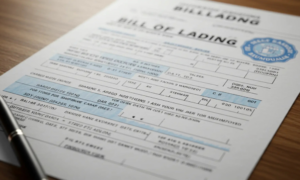
A Bill of Lading is a legal document issued by the carrier to the shipper when goods are loaded for sea transport. In the Netherlands, it is called a cognossement and is defined in Book 8 of the Dutch Civil Code. It applies to sea and inland waterway transport.
A Bill of Lading transaction always involves three parties. The shipper is the party sending the goods. The carrier is the shipping line or transport company that transports the goods and issues the document. The consignee is the party designated to receive the goods at the destination.
A Bill of Lading is typically issued in three originals: one for the carrier, one for the shipper, and one for the consignee. The number of originals is always stated on the document. To collect goods at the destination port, the consignee must present at least one original.
What Must a Bill of Lading Contain?
- Name and address of the shipper and consignee
- Name and details of the carrier
- Description of the goods: type, quantity, weight, and packaging
- Port of loading and port of discharge
- Date of shipment
- Freight charges and payment terms: Freight Prepaid or Freight Collect
- Bill of Lading number for tracking
- Carrier’s signature confirming receipt
The Three Functions of a Bill of Lading
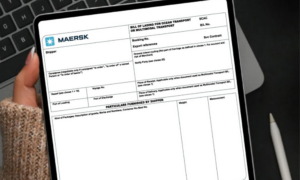
The Bill of Lading is unique because it simultaneously fulfills three completely different functions. No other document in international sea freight performs all three. Understanding each function is essential for anyone handling international shipments.
Receipt of Goods
When the carrier issues the Bill of Lading, it serves as an official receipt. It confirms that the goods have been received in the stated condition and quantity. This provides proof for the shipper that the goods were correctly handed over to the carrier.
If goods arrive damaged at the destination, the condition documented on the Bill of Lading becomes the starting point for any claim.
A clean Bill of Lading means the goods were received in good condition without any noted damage. An unclean or claused Bill of Lading means the carrier recorded damage or discrepancies when loading the goods.
Banks and financial institutions generally reject a claused Bill of Lading and refuse to release payment against it.
Evidence of the Contract of Carriage
The Bill of Lading provides evidence of the transport agreement between the shipper and the carrier. It is important to understand that the Bill of Lading is not the contract of carriage itself. The contract already comes into existence when the booking is confirmed by both parties.
The document describes the key transport terms, including the destination, freight charges, and the carrier’s responsibilities. The full transport conditions are usually printed on the reverse side of the Bill of Lading.
Document of Title: Proof of Ownership
This is the most powerful function of the Bill of Lading and what distinguishes it from every other shipping document. Whoever possesses the original Bill of Lading has the legal right to claim the goods at the destination. Ownership of the cargo is inseparably linked to the document itself.
This means that goods can be bought and sold multiple times while still at sea simply by transferring the original Bill of Lading to another party. This is especially common in commodity trading, where ownership changes during transport.
It is also the reason banks use the Bill of Lading as security in Letter of Credit transactions. The bank holds the original document and releases it to the buyer only after payment has been received.
Main Types of Bill of Lading
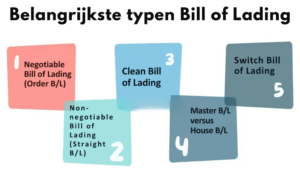
Not all Bills of Lading work in the same way. The type you use depends on whether ownership needs to be transferred, who the consignee is, and how payment is arranged.
Choosing the wrong type can lead to delays, payment issues, or problems releasing cargo at the destination.
Negotiable Bill of Lading (Order B/L)
Can be transferred to a third party through endorsement. Used when goods may be resold during transit or when a Letter of Credit is involved. The consignee is stated as “to the order of” a named party. This is the most common type in international trade.
Non-Negotiable Bill of Lading (Straight B/L)
Specifies a particular consignee that cannot be changed. It cannot be transferred to another party. Used when payment has already been made or between trusted trading partners where no transfer of ownership is required.
Clean Bill of Lading
Confirms that the goods were received in good condition without the carrier noting any damage or defects. Banks require a clean Bill of Lading before releasing payment under a Letter of Credit. Always ensure a clean B/L is obtained before the goods depart.
Master B/L vs. House B/L
The Master B/L is issued by the shipping line to the freight forwarder. The House B/L is issued by the freight forwarder to the shipper. Both documents are required for consolidated or LCL shipments where multiple shippers share one container.
Switch Bill of Lading
A replacement B/L issued when the shipper wants to conceal the identity of the original supplier, for example when goods are resold. The original B/L is surrendered and a new one is issued in its place.
Bill of Lading vs. Sea Waybill: What Is the Difference?
The Bill of Lading and the Sea Waybill are often confused, even by experienced shippers. In the Netherlands, the Sea Waybill is known as a zeevrachtbrief and differs fundamentally from a Bill of Lading.
Choosing the wrong document can have serious consequences for cargo release and payment.
Bill of Lading
A document of title that gives the holder the legal right to claim the goods. It can be negotiable or non-negotiable. The original document must be physically presented at the destination port to release the cargo. Essential for Letter of Credit payments.
Sea Waybill
Not a document of title. It serves only as evidence of the contract of carriage and as a receipt for the goods. No original document is required at the destination. Cargo is released to the named consignee based on identification. Faster and simpler, but it does not provide ownership protection.
When Should You Use a Bill of Lading?
When you want to retain ownership until payment is received, when goods may be resold during transport, when payment is made through a Letter of Credit, or when working with a new or unfamiliar trading partner.
When Should You Use a Sea Waybill?
When you have a trusted relationship with the buyer, payment is already secured, and you want faster cargo release without document handling.
According to the Dutch Chamber of Commerce (KVK), a Bill of Lading proves ownership and gives the shipper control over the cargo. A Sea Waybill serves only as proof of transport and receipt.
Bill of Lading and International Payment
The Bill of Lading plays a central role in international payments, particularly in Letter of Credit transactions. Banks require a complete set of clean on-board Bills of Lading before releasing payment.
Obtaining a clean B/L at the time of loading is crucial. An unclean or claused B/L may cause the bank to refuse payment entirely.
The Bill of Lading also states how freight charges are paid. This is directly linked to the Incoterm agreed in the sales contract.
Freight Prepaid
The seller has paid the freight charges before the goods were loaded. Common under Incoterms where the seller arranges transportation, such as CFR, CIF, CPT, and CIP.
Freight Collect
The buyer pays the freight charges upon arrival at the destination port. Common under Incoterms where the buyer arranges transportation, such as FOB and FCA.
Ensure Correct Bill of Lading and Customs Clearance Every Time
In the Netherlands, Bill of Lading details are required as part of the Cargo Import Pre-Notification (Voormelding Lading Import), which is submitted through Portbase.
This notification must include all B/L party details, including the consignor, consignee, and notify parties together with their EORI numbers. Errors in Bill of Lading information can cause delays with Dutch Customs and hold up cargo release at the port.
Are you looking for a reliable and AEO-certified customs service provider in the Netherlands? The Customs Company handles all Bill of Lading documentation and import pre-notifications for you.
With direct connections to Dutch Customs and Portbase, and 24/7 support, your Bill of Lading data and customs declarations are processed correctly and on time every time.
Frequently Asked Questions
Q. What is the difference between a Bill of Lading and a Sea Waybill?
Ans: A Bill of Lading is a document of title that determines ownership of the goods. A Sea Waybill is only proof of transportation and receipt and cannot be transferred.
Q. How many original Bills of Lading are issued?
Ans: Typically, three originals are issued: one for the carrier, one for the shipper, and one for the consignee. The number of originals is always stated on the document.
Q. What is a clean Bill of Lading?
Ans: A clean Bill of Lading means that the carrier received the goods in good condition without any noted damage. Banks require a clean B/L before releasing payment under a Letter of Credit.


