HS Code Explained: Classifying Goods and Calculating Import Duties
Every product that crosses an international border requires a code. That code tells customs exactly what the product is and how much import duty applies. The HS code is that number. Using the correct code determines how much you pay at customs and whether your shipment is released without delay.
The HS code is part of the Harmonized System (HS), a global classification system used in more than 200 countries. The system covers approximately 98% of all international trade.
In the Netherlands, the HS code is also referred to as a GS code, which stands for Harmonized System (Geharmoniseerd Systeem). The system is managed by the World Customs Organization (WCO) and is updated every five to six years.
In this article, we explain what an HS code is, how the EU expands it with CN codes and TARIC codes, how to calculate import duties, and what happens when the wrong code is used.
What is an HS code?
The HS code stands for Harmonized System code, officially known as the Harmonized Commodity Description and Coding System. The system was developed by the World Customs Organization (WCO) and was introduced in 1988.
More than 200 countries use the same HS codes, making this system the universal language of international trade. Around 98% of all internationally traded goods are classified within this system.
Each product that is imported or exported is assigned a unique numerical HS code based on the nature, type, and purpose of the product.
Customs authorities use this code to identify goods, determine import duties, apply trade regulations, and collect trade statistics. The HS code is always mandatory on customs declarations and commercial invoices.
The HS system is not static. The WCO updates it every five to six years to include new products, technologies, and changes in global trade.
The most recent update took place in 2022. Since codes change, businesses must regularly check whether the HS codes they use are still up to date.
How is an HS code structured?
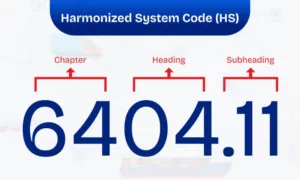
Each HS code consists of six digits structured according to a fixed hierarchy. The first two digits represent the chapter, which is the broad product category. The next two digits represent the heading, a more specific product group within that chapter.
The last two digits form the subheading, the most precise classification level at the international level. The system consists of 21 sections, 97 chapters, and around 5,000 product groups.
The 21 sections cover all categories of goods traded internationally. They range from live animals and food products in the early chapters to machinery, electronics, and transport equipment in the middle chapters, and works of art in the final chapters.
Each section and chapter contains detailed legal descriptions to ensure products are classified consistently across all countries.
Below is a practical example of how this structure works:
Product: Leather handbag
HS code: 4202 21
- 42 = Chapter: trunks, suitcases, handbags and similar articles
- 02 = Heading: handbags, with or without shoulder strap, including handbags without handles
- 21 = Subheading: with outer surface of leather
HS code, CN code, and TARIC code in the EU
Although the 6-digit HS code is used worldwide, the EU adds extra digits for more detailed classification. Dutch businesses must know which code applies to their situation, whether they are exporting from or importing into the EU.
Using the wrong code on a customs declaration can lead to delays and fines.
The HS code: 6 digits, international
The 6-digit HS code forms the international basis and is used by more than 200 countries and economies. In the Netherlands, it is also called the GS code (Harmonized System).
It is the starting point for all EU-specific codes. The same six digits are used in every country’s tariff system, making the HS code the common language of international trade.
The CN code: 8 digits, for export from the EU
For exporting goods from the EU to non-EU countries, companies need an 8-digit code: the CN code (Combined Nomenclature).
The CN code consists of the 6-digit HS code plus two additional digits added by the EU. The CN code is mandatory on export declarations to Dutch Customs.
It also indicates whether export restrictions apply, such as export licenses or health certificates.
The TARIC code: 10 digits, for import into the EU
For importing goods from non-EU countries into the Netherlands, companies need a 10-digit TARIC code. TARIC stands for the Integrated Tariff of the European Union.
The TARIC code consists of the CN code plus two additional digits that specify exact import measures and duties. For products subject to anti-dumping duties, the TARIC code may be extended further.
The TARIC code shows the exact import duty rate, whether tariff preferences apply, and which documents or certificates are required for your product.
Below is how the same product looks under each code type:
Type code | Transaction | Code
HS code | International | 4202 21
CN code | Export from EU | 4202 21 00
TARIC code (handmade) | Import into EU | 4202 21 00 10
TARIC code (machine-made) | Import into EU | 4202 21 00 90
How to find your code and calculate import duties

Once you have the correct TARIC code for your product, you can calculate the exact import duty rate and determine how much you need to pay. In the EU, import duties are calculated based on the customs value of your goods.
The customs value consists of the price paid for the goods plus transport and insurance costs up to the EU border or port of entry.
Below is a practical example of how this calculation works:
- Product: 30,000 tempered glass tumblers imported from China
- Goods value: €10,000
- Transport and insurance costs to EU border: €2,000
- Customs value: €12,000
- Import duty rate (TARIC code): 11%
- Import duties payable: €1,320
What happens if you use the wrong HS code?
Using the wrong HS code is one of the most expensive mistakes an importer or exporter can make. Incorrect classification can result from product complexity, unclear descriptions, human error, or outdated codes.
Regardless of the cause, responsibility lies with the registered importer.
Possible consequences:
- Shipment delays: customs may hold goods for inspection
- Fines and penalties: even for unintentional errors
- Post-clearance recovery: duties may be claimed up to three years back
- Loss of preferential tariffs: reduced tariff benefits may be lost
- Increased customs inspections: more frequent audits
Ensure correct HS codes with expert customs support
Finding and verifying HS, CN, and TARIC codes requires expertise. Incorrect codes can lead to delays, fines, and back payments of duties.
The Customs Company is an AEO-certified customs service provider in the Netherlands, with direct connections to Dutch Customs and Portbase.
With 24/7 support, they ensure your HS codes, TARIC codes, and duty calculations are always handled correctly.
Frequently asked questions
Q: What is the difference between an HS code and a TARIC code?
Ans: The HS code is the international 6-digit base code. The TARIC code is the EU 10-digit import code that adds tariff and regulatory details.
Q: How do I find the correct HS code for my product?
Ans: Use the Dutch Customs Tariff Database or Access2Markets. For legal certainty, request a Binding Tariff Information (BTI).
Q: What happens if I use the wrong HS code?
Ans: Customs may impose fines, reclaim duties up to three years back, hold shipments, and remove tariff benefits.