Exporting to Switzerland from the EU: customs and VAT
Key points
- Switzerland is not in the EU or the EU customs union. Every commercial shipment needs an export declaration in the EU and an import declaration with Swiss customs, the BAZG.
- Since 1 January 2024 Switzerland charges no import duty on most industrial goods (chapters 25 to 97). The declaration is still required, and so is Swiss import VAT at 8.1 percent.
- Agricultural products and food still carry Swiss duty. That is where a statement on origin or an EUR.1 under the EU and Switzerland free trade agreement saves money.
- No advance safety and security notification is needed for goods moving between the EU and Switzerland, thanks to the agreement on customs facilitation and security.
- You keep the zero VAT rate on the sale only if you can prove the goods actually left the EU.
A Dutch manufacturer of packaging machines ships spare parts to a customer near Zurich. There has been no Swiss duty on those parts since 2024, so the sales team assumes customs has become a formality. Then a truck waits a full day at the Swiss border, because the Swiss import declaration was not ready and nobody had agreed who would file it.
That is the common mistake with Switzerland. The duty is gone for many goods, but the border is not. You still file two declarations in two countries, and your Swiss customer still pays import VAT.
Below are the steps, who files which declaration, and where shipments get stuck in practice.
What customs formalities apply when exporting to Switzerland?
Two declarations: an export declaration in the EU and an import declaration in Switzerland. In between, the goods travel under customs control to the border or to a clearance point inside Switzerland.
- You file the export declaration with Dutch customs before the goods leave. They may not be exported until customs releases them. How that works is covered in our guide to the export declaration.
- The export declaration needs an EORI number. If you do not have one yet, see how to apply for an EORI number.
- The import declaration is filed with the BAZG. Anyone declaring electronically needs a Swiss UID, the business identification number of the Swiss customer or its service provider.
The BAZG requires the goods declaration to be available when the goods enter Swiss customs territory. A truck that reaches the border without one stops there, even when no duty at all is due.
Who files the Swiss import declaration?
Usually the Swiss buyer or its customs service provider. It depends on the Incoterm in your contract. If you sell DDP, the import is your responsibility, including Swiss VAT.
Switzerland is also changing systems. The BAZG is replacing e-dec Import with Passar in stages: the changeover runs from the second quarter of 2026 to the first quarter of 2027, and import declarations can still be entered in the old system until 30 September 2027. Little changes for you as the exporter, but your Swiss customer or its provider has to be ready for the new system.
So agree before the first delivery who files the Swiss declaration and who pays the import VAT. A DDP price without a Swiss partner for the declaration is a promise you cannot keep.
Does your Swiss customer still pay import duty?
Not on most industrial goods. Since 1 January 2024 Switzerland has abolished import duty on goods in chapters 25 to 97 of its tariff, such as machinery, parts, clothing and raw materials. A few products in chapters 35 and 38 count as agricultural products and remain dutiable.
What remains:
- Swiss import VAT. The standard rate is 8.1 percent, the reduced rate for goods such as food, medicines and books 2.6 percent.
- Import duty on agricultural products and food in chapters 1 to 24.
- Import bans, licences and certificates for certain goods.
Trucks over 3.5 tonnes also pay the Swiss performance-related heavy vehicle charge. It is usually built into the haulier’s rate, but it explains part of the freight price.
When do you need an EUR.1 or a statement on origin?
When your goods carry Swiss duty, or when your customer exports them onwards. Under the free trade agreement between the EU and Switzerland, goods with preferential EU origin get a reduced or zero rate, but only with proof of that origin.
- Up to 6,000 euros per consignment, you as the exporter can put a statement on origin on the invoice.
- Above that threshold you need an EUR.1, unless you hold approved exporter status.
For industrial goods that stay in Switzerland, the BAZG no longer asks for proof of origin. There is one exception that is easy to miss: if your customer processes the goods and exports them to a country Switzerland has a free trade agreement with, it does need your proof of origin. Ask before you leave the statement off the invoice. The difference between EUR.1 and REX is explained in our post on the certificate of origin.
How does the shipment cross the border?
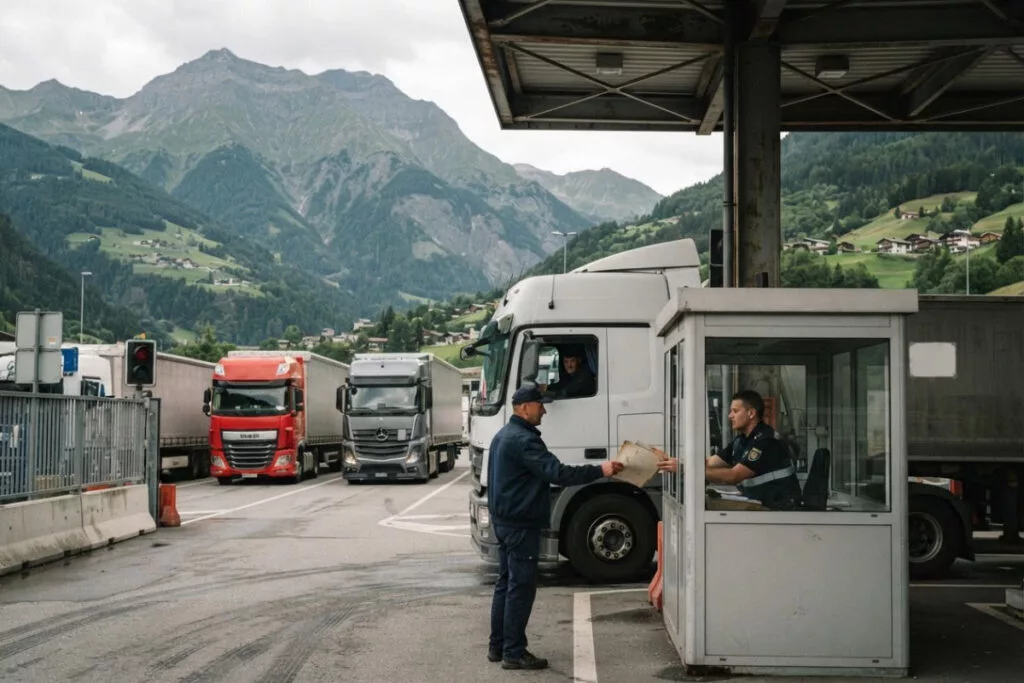
By road, a shipment from the Netherlands usually runs through Germany to the Swiss border. Two routes are common.
- The goods travel under the export declaration to the border office, where their exit from the EU is recorded and the Swiss import declaration follows.
- The goods travel under a T1 transit document to a clearance point inside Switzerland. Switzerland is a party to the common transit convention. How that works is covered in our guide to T1, T2 and T2L documents.
One advantage over the UK: under the agreement on customs facilitation and security between the EU and Switzerland, EU security measures for third countries do not apply to Switzerland, such as the obligation to notify imports in advance. A separate pre-notification, as needed when exporting to the UK from the EU, is not required.
How do you keep the zero VAT rate?
With proof that the goods left the EU. A sale to Switzerland is an export, so you charge zero percent Dutch VAT. That is only allowed if you can show the exit, and the exit confirmation on your export declaration is the strongest evidence.
This is where EXW goes wrong. If the Swiss buyer collects the goods and arranges the export, you often never receive that confirmation. In an audit, the Dutch tax authority can then charge Dutch VAT on the sale after all. If you sell EXW, agree that the buyer sends you the proof of exit, or choose a term where you have the export declaration filed yourself.
Frequently asked questions
Q: Do I still need to declare now that Switzerland has dropped duty on industrial goods?
Ans: Yes. The abolition only covers the duty. You still file an export declaration in the EU, and Switzerland still needs an import declaration, not least for its 8.1 percent import VAT.
Q: Who pays Swiss VAT on import?
Ans: Usually the Swiss buyer, through its own declaration or its service provider. If you sell DDP, that obligation is yours. Agree it before you send the quotation, because the VAT comes on top of the value of the goods.
Q: Do I need an EUR.1 for Switzerland?
Ans: Only if you want to use the preference. That mainly matters for agricultural products and food, or when your customer exports the goods onwards. Up to 6,000 euros per consignment a statement on origin on the invoice is enough; above that you need an EUR.1, unless you are an approved exporter.
Q: How long does customs clearance for Switzerland take?
Ans: With complete documents, the Dutch export declaration is done within hours. Delays usually happen at the border, when the Swiss declaration is not ready or the goods description on the invoice is too vague.
Q: Can I outsource the export declaration for Switzerland?
Ans: Yes. A customs broker files the export declaration, arranges the transit document where needed and aligns the data with the haulier and the Swiss side. You sign a one-time authorisation for this.
Exporting to Switzerland and want the EU side right the first time? As an AEO-certified customs broker we handle export declarations and transit documents, check the origin details on your invoice in advance and also work at weekends and at night. See our customs services or sign the authorisation, and we take care of the rest.