
Article 23 licence: reverse charging import VAT
Key Takeaways
- With an Article 23 licence you report import VAT on your VAT return and deduct it in the same return, instead of paying it directly at customs.
- On a shipment of 100,000 euro this saves 21,000 euro you do not have to pre-finance.
- The application is filed on paper: printed, signed and posted to the Dutch tax authorities in Heerlen, with no digital route available.
- Foreign entrepreneurs cannot apply for the licence themselves and need a general fiscal representative with their own Dutch VAT number.
- The most common mistake happens in the VAT return: the amount reported in box 4a must come from the customs assessment, not the supplier invoice.
With an Article 23 licence you do not pay import VAT to customs. Instead you report it on your next VAT return and deduct it on that same return. On balance you pay nothing, and that saves you exactly the amount that would otherwise sit with the tax authorities for months.
On a shipment of 100,000 euro that is 21,000 euro you do not have to pre-finance. At five containers a month it adds up to an amount that visibly changes your liquidity.
The scheme is well known, but applying it often goes wrong. Not at the application stage, but in the VAT return that follows: the amount you report in box 4a comes from the customs assessment, not from your supplier’s invoice. Anyone who confuses those two reports the wrong figure for years.
In this article we explain how the reverse charge on import works, who can apply for it, what foreign entrepreneurs must do when they cannot obtain a licence themselves, and how to process import VAT correctly on your return.
What does the reverse charge on import mean?
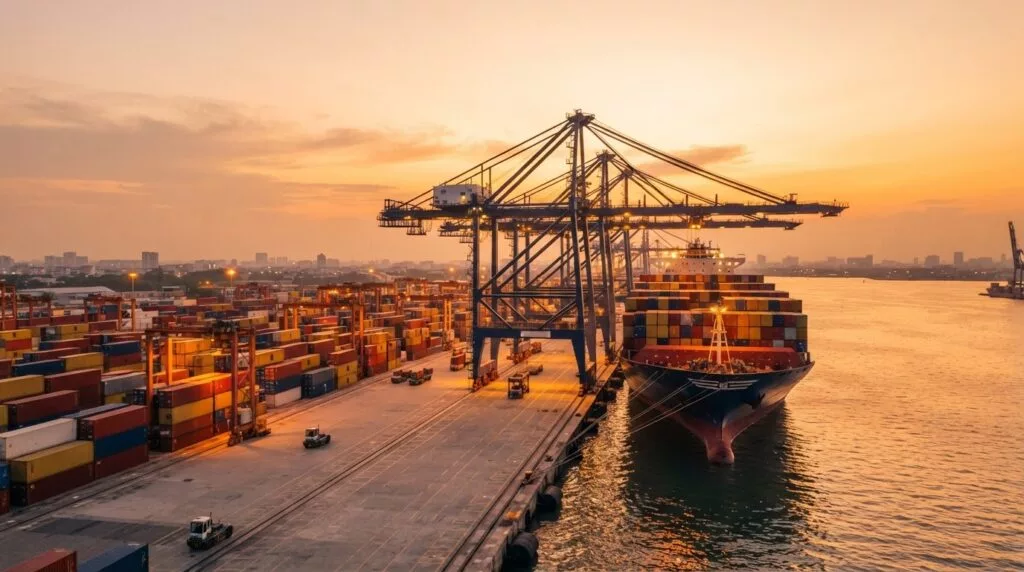
Normally you pay VAT directly to customs when importing goods from outside the EU, at the same time as the import duties. You get that money back later through your VAT return, but until then it is tied up.
The Dutch tax authorities describe the effect of the licence briefly: with an Article 23 licence you do not have to declare and pay VAT to customs on every import, and you can defer payment to your next VAT return.
On that return you declare the import VAT due and deduct it as input tax on the same return. For an entrepreneur with a full right of deduction, the balance therefore comes out at zero. Nothing changes about what you ultimately pay, only about when.
That is also why the scheme is crucial for one importer and barely matters for another. If you import a small shipment twice a year, the difference is limited. If you run containers weekly, it is the difference between working capital that flows and working capital that does not.
Who can apply for an Article 23 licence?
The licence is intended for entrepreneurs established in the Netherlands who import goods from outside the EU with some regularity and keep records from which the imports and the VAT due are clearly apparent.
That last condition is underestimated. The licence is not about your turnover but about whether you can demonstrate which VAT belongs to which import. Records in which customs documents and bookkeeping entries cannot be tied to one another are the most common reason things go wrong later.
The application itself is strikingly old-fashioned. You print the form, sign it and post it to the tax authorities in Heerlen. There is no digital route. Allow for processing time and apply before your first large shipment is on the water, not after.
What do foreign entrepreneurs do when they cannot obtain a licence?
If you are not established in the Netherlands, you cannot apply for the licence yourself. The tax authorities are explicit about this: as a foreign entrepreneur you cannot apply for an Article 23 licence yourself.
There are then two routes, and the difference between them determines how much Dutch administration you take on.
General fiscal representative
You appoint a general fiscal representative who arranges a Dutch VAT number and an Article 23 licence on your behalf. You are then liable for VAT in the Netherlands yourself and file returns here, through your representative.
This route fits when you also make domestic supplies, hold stock in the Netherlands, or want your own VAT position here.
Limited fiscal representative
You use the Article 23 licence of a limited fiscal representative. The tax authorities describe the mechanism this way: the fiscal representative reports the VAT you owe on the VAT return for that period, and deducts that same VAT as input tax on the same return.
The advantage is that you do not have to register separately for VAT in the Netherlands. This is the route most foreign importers choose when they only import goods and supply them straight on to another EU member state.
You can read more about the differences and what a representative arranges for you in our article on fiscal representation in the Netherlands.
How do you process import VAT on your return?

This is the part that goes wrong in practice, and it goes wrong quietly. The return looks right, the deduction runs, and only during an audit does it emerge that the amount never reconciled.
You declare the import VAT due in box 4a of your VAT return and deduct it as input tax on the same return. So far it is simple. The question is which amount.
The answer: the amount that follows from the customs assessment. That amount is based on the customs value plus the import duties and any excise duties, and it is almost never equal to your supplier’s invoice amount.
- The customs value contains freight and insurance costs up to the external border of the EU, your purchase invoice usually does not
- The import duties are in the VAT base and are not on your purchase invoice
- Exchange rates differ between your purchase administration and the rate customs applies
Declaring and deducting are moreover two separate assessments. If something is wrong with the deduction, for example because the goods are not used for taxed supplies, the obligation to declare stands and the amount remains due.
Structurally reporting the wrong figure can ultimately lead to the licence being withdrawn. That is a heavier consequence than most importers expect from what looks like a bookkeeping error.
When is the licence worth considering?
The sum is easy to make. Take your average import value per month, add the import duties, and multiply by your VAT rate. That amount is what sits permanently tied up in the chain without a licence.
Against that, the scheme places demands on your records, and during an audit you must be able to show that every euro reported traces back to a customs document. That is not an objection, but it is work.
In practice the licence is almost always worth it as soon as you import more than incidentally, and almost always a source of corrections as soon as nobody watches the reconciliation between customs and bookkeeping.
Expert support with import VAT and Article 23
An Article 23 licence is quickly applied for and slowly gone wrong. The application is a form, the execution is a monthly reconciliation between customs documents, purchase administration and VAT return.
For foreign entrepreneurs there is the added choice between a general and a limited fiscal representative, and that choice determines whether you take on your own VAT position in the Netherlands.
The Customs Company is an AEO-certified customs service provider in the Netherlands with direct connections to Dutch Customs and Portbase.
We handle the import declaration, supply the customs assessment on which your box 4a is based, and act as fiscal representative for foreign entrepreneurs who cannot apply for an Article 23 licence themselves.
Frequently asked questions
Q: What is the difference between the VAT reverse charge and an Article 23 licence?
Ans: They are two names for the same thing. The reverse charge on import is the scheme, the Article 23 licence is the document that lets you apply it. Without the licence you pay import VAT to customs, with it you shift it to your own VAT return.
Q: Do I need a licence for every shipment?
Ans: No. The licence applies to your company, not per shipment. Once it has been issued, import VAT is shifted to your VAT return for all your import declarations, as long as the declaration is in your name and under your EORI number.
Q: Can my customs broker arrange this for me?
Ans: You submit the application yourself, but a customs broker can prepare it and set up the administration around it. If you are not established in the Netherlands, a fiscal representative can use their own Article 23 licence for your imports, and then you do not have to apply at all.
Q: Which amount do I enter in box 4a?
Ans: The amount from the customs assessment, so the customs value plus import duties and any excise duties. Not your supplier’s invoice amount. That difference is the most common error in applying the licence and it is exactly what an audit reconciles.
Q: What happens if I import without an Article 23 licence?
Ans: You pay the import VAT directly to customs, at the same time as the import duties, and reclaim it later through your VAT return. You lose nothing, but the money is tied up until that return. With regular imports that is a permanent claim on your working capital.